
May 1st, 2026 | John Dines
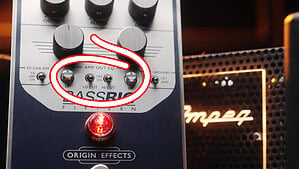 It’s been a while since we’ve had a nerdy deep-dive into our engineering reasoning here at Origin Effects, and this month’s foray takes us into the post-drive quarters of the BASSRIG Fifteen. In fact, the specific topic we’re tackling is so finicky we haven’t even bothered putting it in the manual!
For those of you who don’t know, the BASSRIG Fifteen is from our range of analogue bass preamp and DI pedals, and it simulates the entire Ampeg B-15 Portaflex amp from top to toe, including a full amp topology and cabinet simulated DI output.
The Ampeg B-15 is an interesting little amp – small, low-powered, and featuring a unique sounding ported 1×15 cab. It’s unusually tight in the low end, warm on top, and has a fat, punchy tone that perfectly finds its place in the mix. That’s why it’s probably the most recorded bass amp in history.
This cab is so intrinsic to the sound that a pedal replica of this amp simply wouldn’t be complete without a faithful simulation of a properly mic’ed up cabinet. In our BASSRIG Fifteen, this cab sim feeds the DI output, so that you have a “finished” B-15 tone running straight to the PA. But what about your sound on stage?
The kind of full-range, modern bass amp that most folks use for on-stage monitoring is miles away from the sound of the humble B-15, so how do you get your stage tone to have the same vintage vibe as the sound your audience hears?
At Origin Effects, we’re not fans of running a cabinet simulated sound through a real cab. Sure, modern bass cabs claim to have a flat response, but there’s always some speaker character in there, and running a cab sim through that sound is never quite right. Having no extra tone shaping wouldn’t work either. It would be tempting to mess with your amp’s EQ to get the B-15’s punchy lows and rolled-off treble through your stage amp, but we don’t like leaving things to chance.
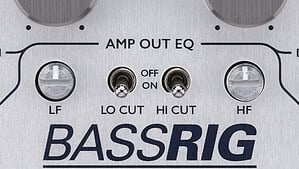 In the BASSRIG Fifteen we left the cab sim off the ¼” output, and added Lo Cut and Hi Cut switches that only affect that output. These essentially lop the low and high frequencies off in a particular way, leaving you with a frequency response from your amp’s cab that’s much more in line with the B-15 cab. But here’s where things get interesting (a term open to interpretation).
When you record a cab, you’re not just recording the cab. You’re recording the sonic footprint of the microphone and its placement on the speaker, and that’s part of what you’re going for in the PA or on your record. So that’s what you hear in the BASSRIG Fifteen’s cab sim – the sound of the cab, plus the AKG D12 microphone placed in a way that gently emphasises those punchy upper bass frequencies.
But that’s not the same as what you hear in the room with the amp. And that is what you want from your amp on stage. You want to be able to kick on the pedal and feel like the amp beside you has transformed into a real B-15, and that required a different approach.
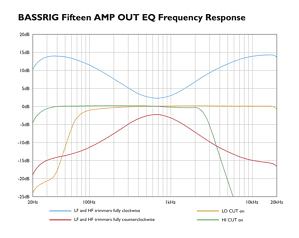
BASSRIG FIFTEEN – Amp Out EQ Graph
For the Lo Cut switch, we didn’t just add the same low-frequency EQ shape from the analogue cab sim. Instead, we based the Lo Cut on an entirely different measurement of the cab. Rather that mic’ing it up for a “recorded tone” – using a mic with character placed close to the speaker to exaggerate the sound – we took a more scientific approach. The Lo Cut EQ shape was created by using a very flat-response reference microphone, placed much further from the cab. This method captures the sound of just the cab itself, with no mic colouration, heard from a distance much more like where you’d be stood on stage.
So, in addition to a bang-on recreation of all the amp circuitry, your BASSRIG fifteen comes with a record-ready DI cab sim and transforms your on-stage amp into an honest B-15 tone, without the polish or hype. Because, as anyone who’s played the real thing will tell you, being in the room with an Ampeg B-15 Portaflex is even better than hearing one on record!