
November 5th, 2026 | Jacob Holdsworth
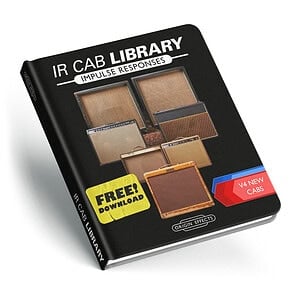 Since launching the Origin Effects IR Cab Library in 2024 with six cabinet captures, we’ve continued expanding the collection with new additions including a Tweed Deluxe cabinet for the DELUXE55 launch and two expansion packs. Today, the library contains 11 professionally captured cabinets, all available as free downloads.
The Problem –
Cabinet impulse responses are a core part of our workflow at Origin Effects. We rely on them when developing pedals, auditioning amplifiers, creating video content and, for many of us, in our own personal rigs.
However whenever the subject of IR came up, we found ourselves returning to the same frustrations.
- There is way too much choice. It’s very easy to get yourself into a sonic-hole, going through IRs like snare samples. Listening with no reference, only hearing the weird differences between IRs.
- The cost and complexity. IRs take time and money to make (lord don’t we know it) so people charging for IRs is totally reasonable. That said, as a purchaser the process by which they were packaged was always a bit frustrating. £10-20 per cab, which you’re unable to demo, largely containing a bunch of mic positions and types that you’ll never use. We often found ourselves buying whole packs and using 1 or none of the files, with the other 500 files from the pack collecting digital-dust. Realistically, in our personal rigs we just wanted a few different cabs to play with, rather than 1 cab with half a million options.
- We wanted the real cabinets that belonged with our amps! We own the real amps our pedals are based on, and Simon is a nut for vintage authenticity, so we own the cabs and correct speakers too. Yet until recently, there was no straightforward way to pair our pedals with captures of those exact cabinets. We wanted to experience the complete amplifier and cabinet combinations we’d spent so much time studying, wherever we happened to be playing.
Those frustrations eventually led us to ask a simple question: what would an IR pack look like if we built it entirely for ourselves?
 The Solution –
Now hear me out, what if we took all our amps and scientific speaker measurement equipment to a high-end recording studio, and captured them. Between our own studio experience and the expertise of Stuart Jones, owner and chief engineer at Woodworm Studios, we should have the necessary aural abilities to pull off such a feat.
So that’s what we did. We loaded up enough cabinets to make Joe Bonamassa blush and headed to the studio.
When approaching our pack, we wanted to focus heavily on usability and cab selection. We chose to forgo the extensive mic selection and position approach of other packs entirely. Instead of providing endless microphone and positioning variations, every cabinet includes just three carefully curated mixes:
- Bright
- Medium
- Dark
Each capture is a blend of multiple microphones, balanced exactly as we’d balance a cabinet during a real recording session.
We figured guitarists don’t want to spend their time comparing microphone models, placement distances or off-axis angles. They just want to plug in and play. Our goal was to hide that complexity behind a handful of considered options.
To find the right microphone combinations, we recorded clean, edge-of-breakup and fully driven performances using the matching Amp Recreation pedal for each cabinet. A Brown Deluxe cabinet was auditioned using the DELUXE61, a Tweed Deluxe with the DELUXE55, and so on.
We chose mics and dialled in the position by ear, running the mics through an Solid State Logic Duality used purely for its pristine preamps and analogue summing capabilities. Rather than blending microphones inside a DAW, we balanced them using the console’s physical faders and committed those mixes in analogue before capture. This mirrored the way we’d approach recording a guitar cabinet for a finished track and helped give each mix a cohesive, record-ready character.
We also captured all of the individual microphones, so anyone wanting to go deep-diving can do exactly that. The catch? Even we couldn’t tell you the exact mic positions. Every sound was dialled in by ear rather than measured out with a tape measure.
The Verdict –
Today, the Origin Effects IR Cab Library is closing in on 40,000 downloads and remains the only IR collection we use across product development, testing and content creation. The same cabinet captures you’ll find in the library are the ones you’ll hear throughout our demos and videos. So if you’ve ever wondered how we achieved a particular sound, the solution is already available, completely free to download.
You can download the full pack with both expansions at the link below: