November 27th, 2026 | Alex Auxier & Ben Flanders
1. As Ella Langley’s guitarist and musical director, how does your role in shaping the overall live show influence the way you approach your own playing?
A: “I think being a musical director gives you a completely different 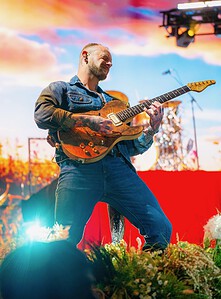 perspective on your instrument. I’ve always been someone who pays a lot of attention to detail, but now I’m listening to everything happening around me, not just my guitar. I’m thinking about dynamics, transitions, arrangements, and how the whole band is interacting. It actually gives me a lot of freedom as a player because I’m more focused on the impact of what I’m playing rather than how much I’m playing. I think it’s made me a more intentional guitar player. Everything has to serve the song and the overall energy of the show.”
2. Having played on Ella’s record, you’ve helped bring her blend of country, rock, grit, and attitude to life. As her musical director, what feels essential to preserving that sound onstage?
A: “For me, it’s really about preserving the attitude and emotion of the recordings while bringing more energy and excitement to the live show. There’s a rawness to Ella’s music that I think is really important. The goal isn’t necessarily to recreate every little detail exactly as it was recorded, but to capture the same emotion and character and bring extra energy to the arrangements and moments we create live. Ella’s music has this really cool balance of traditional country influences and raw rock-and-roll energy. Maintaining that balance is probably one of the biggest things I focus on when we’re putting the live show together.”
3. When you’re building guitar parts for an artist like Ella, how do you balance serving the song with still bringing personality to the part?
A: “I think the trick is finding where your personality fits naturally into the music rather than trying to force it in. I’ve spent a lot of my career playing different styles, and one thing I’ve learned is that restraint can be just as powerful as playing something technically impressive. Sometimes I’ll harmonize a melody Ella is singing in the chorus, or I’ll double a keyboard part that might be faint on the album to give it more emphasis. I’m always trying to find something that complements the vocal and adds something unique to the song. I love interesting voicings, textures, and little melodic details. Sometimes it’s a really simple hook or a particular guitar tone that creates a mood. I think the best guitar parts are the ones where you can’t imagine the song without them.”
4. Country-rock guitar can cover a lot of ground: clean articulation, edge-of-breakup rhythm, heavier moments, hooks, and solos. What are you looking for from your guitars, amps, and pedals to cover that range?
A: “I’m really drawn to gear that has its own character but doesn’t dictate how you have to play. I use a lot of different tunings live, so I’ll match certain guitars to specific songs and tunings. I try to stay as close as I can to what I used on the album, but with more versatile pickup layouts. I have a lot of guitars on the road to cover all the tunings and tones, plus backups, but my two main guitars this past year were a Mario Martin Honcho and a JL Custom. I look for character, clarity, and enough flexibility to cover a lot of ground.”
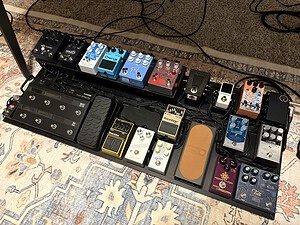
5. What does your current live rig look like, and how does it need to function for Ella’s set?
A: “Live, I’m currently running two Fractal Axe-Fx III units with a rack-mounted pedal drawer and an FC-12 onstage. I’m pretty obsessive about tone and how an amp or modeler feels under the fingers, so even though I’m using a digital platform live, my approach is still very much rooted in running pedals into the front end of vintage amps, like I did on the album. Having the pedal drawer lets me experiment and incorporate some of that character into a really flexible setup. Ella’s show covers a pretty wide range of sounds, so I need a rig that can transition seamlessly from ambient, edge-of-breakup tones to pushed, gritty rock sounds. For me, it’s all about having the flexibility and consistency of a modern rig without sacrificing the character, dynamics, and feel of an amp.”
6. You’re using an Origin Cali76 FET Compressor. Where does that sit in your chain, and what role does it play in your tone or feel?
A: “Right at the front end! I think a great compressor is something you feel just as much as you hear. I don’t generally want an obviously squashed sound. I’m looking for something that adds a little consistency and sustain while keeping the guitar alive.”
7. You also have the Origin M-EQ Driver. Are you using that more as a tone-shaping tool, a boost, or something that helps certain guitars and amps sit right in the mix?
A: “I’ve always been a huge fan of analog-style EQs, especially the way they can shape the whole vibe of a tone rather than just adjusting frequencies. What I like about it is being able to emphasize a particular part of the guitar’s midrange, really push it, and roll off the highs and lows to get a telephone-like sound.”
8. Between the Cali76 FET Compressor and the M-EQ Driver, how much of your board is about shaping the feel under your hands versus shaping what the audience hears out front?
A: “I think those two things are a lot more connected than people realize. The way a rig feels under your fingers directly affects the way you play, and ultimately, that’s what the audience hears. If something responds the way I want it to, I’m going to play with more confidence and expressiveness. I can get pretty obsessive about those little details, but it’s because I think they all add up. The goal is always to make the music feel as good as possible, both onstage and out front.”
